Story vs. Plot

rules-header-full

A notebook for fiction writers and aspiring novelists. One editor’s perspective.

• Next post • Previous post • Index


Story vs. Plot. What’s the dif?
(Also: How to resolve the
“My story’s-too-short” dilemma)

I’m aware of confusion among many newbie novelists concerning the difference(s) between plotting and storytelling. So what exactly is a plot? What exactly is a story? Are plotting and storytelling identical? While the two terms might appear synonymous upon first glance—they are not.

A fictional plot contains a series or sequence of events, circumstances or the collective steps of a journey (physical, emotional, spiritual) that typically begins with an inciting incident and unravel in linear fashion—from your story’s Once Upon A Time… until the conclusive The End.

A story is a fusion of the three primary components necessary to create a complete, believable fictional reality. A story must include: 1. Plot momentum, as well as; 2. Character development, and; 3. Proper (meaning sufficient) scene-setting. A good story will seamlessly blend all three components — and will comprise little else. (See Simple, But Exciting.)

Character development should be self-explanatory. That is, the deeper, more fully formed and complex your characters, the truer-to-life those paper-people will become to readers. Insufficient (wooden, superficial, mundane, re-active*) characters lack the charm, attitude, unique individualism and compassion (for a protagonist) or else lack sufficient heartless, conniving and/or downright evil (your antagonist) qualities. Pro-active characters will skillfully, creatively and intuitively create or solve problems — and proactive protagonists won’t simply and repeatedly react to whatever obstacles a writer dumps in their way.

Proper scene-setting is more than simply visualizing a bare-bones environment for readers. Scene-setting means providing characters with proper stage-setting, and the subtle visualization of all necessary elements in a scene. Scene-setting also allows readers to occasionally stop and smell the flowers (for no other reason than stopping to smell the flowers). With each new scene or chapter you begin, it’s imperative to update (if necessary) the scene’s new whereabouts, any new time frame—has darkness fallen? Have days passed? You’re even noting any mood or emotional shifts in your characters. Your job is to note any relevant changes and make the appropriate updates.

Scene-setting also means providing readers with necessary sounds, smells, and attitudes… so don’t skimp on using a multitude of senses. The aroma of a sizzling steak or the screech of a hungry osprey can be as emotionally relevant to readers as defining a quaint village, a crumbling hillside castle, an angry sea or a cadmium colored sunset. In terms of a timeline, do you begin your new scene on a new day (or night), the following day, next Tuesday, or 2027? So if your last chapter ends around noon, and 10 or 12 pages into your new chapter, readers discover street lamps aglow, you’d have better revealed to us right up front that night has indeed fallen.

Or, to put it very simply:

PLOT: Is what happens.

STORY: Is what happens to whom.

Need more prompting? Okay, so let’s say you want to write a story about a ship sinking. Let’s call this tub the R.M.S. Titanic. A rough outline of your plot might be that of an unsinkable ocean liner speeding across the Atlantic, hitting an iceberg and gradually descending into the icy depths of history. Good plot (and certainly the tragedy’s been written enough). The choreography of the ship’s sinking — the unseen iceberg, the waterproof bulkheads failing, the boilers blowing up, the eventual founding and the ship ultimately splitting in two — that all makes for a riveting plot. But where are the people? How do they cope? Without a host of characters integrated into your story, you’ve basically written a book about buoyancy, or the lack thereof.

But put 2240 souls aboard that sinking ship — and perhaps focus on a dozen of those passengers, each with a different, dramatic, chaotic story to tell — now you’ve turned that very basic plot idea into a very spine-tingly, emotional story. Who’s the hero? Who’s the coward? Who survives? Who doesn’t? Who watches their loved ones go down with the ship? Again, a good story isn’t necessary about the what, it’s about the who.

Finding yourself with a too-short page count?

Many writers, working on early drafts, tend to work primarily on plot-development—which is perfectly okay. When you’re in draft mode, ain’t nothing wrong with outlining or briefly defining your plot from beginning to end before you begin to embellish and elaborate. After all, you want to know where you’re ultimately going and how to get there. And once a writer’s sure of that destination, it’s all about plumping up character personalities and motivations, and grounding readers in the here and now.

Typically, for every 100 pages of plot momentum, one can easily write 50-100 pages of character development as well, plumping up personalities, and adding dramatic side-stories that may actually accentuate nuance and texture, improving upon your current story. And a writer can easily add another 50+ pages of relevant scene/realm setting, adding visual excitement to existing prose. Heck, some writers (and George R.R. Martin comes to mind) can write a dozen pages simply visualizing a feast, setting the table and choreographing a scene before the action even begins.

So if you find your characters with nothing much to do, or moving mechanically through the book, mindlessly following a plot—do realize that there’s room for all sorts of unexpected twists and subtleties, simply based on personality quirks. How many times have you seen a character fail to start a car, when time is of the essence? Those few moments of frustration aren’t directly plot-related, they’re intentional interludes meant to add tension and drama. You’re upping the emotional ante and giving readers additional reasons to turn the page.

Should you decide to throw in a few extra characters to either help or hinder your MC’s efforts, you can add a lotta pages to a manuscript, adding to characters’ personalities or motivations, or setting up future clashes. Not to mention that you’re creating characters far more exciting (clever or scary, unlucky or frivolous or devious…or whatever) for readers to discover. The better built a character, the more opportunities you’ll find to make that character more relevant to your story (should you so desire).

.


* What’s a reactive character? That’s a character who’s always (or most often) responsive to an unfolding plot. Reactive characters typically resolve obstacles through luck or <gasp!> coincidence. (More than one or two discreetly placed coincidences and your novel may begin to feel fake or unbelievable.)

A reactive character wanders from scene to scene, and has little need for personal growth (See: Character Arcs), rational deduction, fortitude or tenacity. Sure, protagonists often initially react to initial drama or danger (again, your novel’s inciting incident) and occasionally to various situations beyond their control, but once a protagonist is motivated, it’s up to him/her to actively confront said drama or danger, to make important decisions and take control of the situation, no matter the risk.

For instance, your disgruntled PI can’t simply solve a crime by sheer luck alone, blundering into clues and having witnesses suddenly pop out of the woodwork, pointing fingers. Your gumshoe must make logical, skillful pro-active choices to solve the case. Or maybe your MC wins the lottery. (Somebody has to. Why not her?) But a character who’s flat broke, finds a dollar bill on the sidewalk and then spends it to win a billion dollar lottery, a day before her eviction, divorce and potential suicide? That’s borderline coincidental. So is the cop who defuses a bomb with 3 seconds remaining on the timer. (How many times have you seen that one? It’s not only coincidental, it’s pretty much a cliché.) Your protagonist(s) must actively rely on their cunning and knowledge to survive (or fall in love, or solve a dilemma or win the big game, or whatever). Sure, protagonists must be occasionally lucky… but too damn lucky? Unless you have an ironclad reason — a literary equivalent of a last-second Hail Mary Pass that wins the Superbowl — that’s pretty much taboo.


• Next post • Previous post • Index
.

Facebooktwitterredditpinterestlinkedinmailby feather

Write the Daydream

rules-header-full

A notebook for fiction writers and aspiring novelists. One editor’s perspective.

• Next post • Previous post • Index


Write the Daydream
(Intro to Plotting)

What’s a novel, but a daydream or fantasy we write down and embellish, expand and hone into something coherent, dramatic and hopefully entertaining?

Sounds simple enough, in theory. But how does one begin? How does one even attempt to begin?* How do so many fragmented and rudimentary thoughts (Hey, I’ll call this dude Romeo. I’ll name his girlfriend Juliette. They’ll live happily ever—no, wait, I have a better idea!) emerge to produce a provocative story? Maybe we gaze longingly at books like A Game of Thrones, or The Lord of The Rings, the Harry Potter series or The Time Ships, and think WTF!? How do people create such rich, complex, creative narratives? What were they thinking? What were they smoking? I could never begin to craft such an incredibly detailed epic adventure! Until I figure it out, I guess it’s back to watching reruns of The Gilmore Girls.

Do realize that before we sit down and actually put words to paper, we may spend weeks, months or sometimes years concocting and babysitting a concept that feels as if it could become a story. And yet some novice or wannabe writers will ponder or percolate (or else procrastinate) for years, waiting either patiently or frantically for Just. The. Right. Moment. to shift from creative daydreaming to actually beginning that first draft.

But until you begin actively writing that first line, that first page, that first scene, that first chapter—let’s face it, you may be lost in an uncertain Twilight Zone between creative inspiration and cranking out pages. Procrastination is a very real issue in a writer’s world and, yes—most writers subliminally know when they’re stalling, hiding behind the veil of “My story needs more research.” Hey, we all procrastinate a bit—but if you’ve spent years yearning to write, and you’ve yet to put a word to paper, you might want to tap out a few pages, just to see what all the fuss is about. (You may surprise yourself and feel an overwhelming sense of pride, or awe, or self-gratification.)

Conversely, some beginning novelists—heads filled with so many exciting possibilities—believe they can plop down one day in front of a notepad or a PC and simply begin to scribble or type out a coherent, fully-developed story. Most of those writers don’t realize that stream of consciousness writing will only get you so far….but then what? Writing a novel requires an incredible amount of pre-prose strategy, of organization and finesse. And most of us will likely require a working roadmap (see Outlining) so we don’t lose ourselves along the way. A few lucky writers are able to simultaneously craft a comprehensive story inside their heads as they write, but that’s an ability most of us do not enjoy.

But let’s back up a sec, to the aforementioned …but then what? Three of the most important words for a writer to comprehend. Because most, if not all novels begin with a single What if…? notion or premise. A novel is a logical, sequential series of What if…? scenarios. No sooner than you’ve answered one, another What if…? question should arise—a series of dramatic questions and answers that end only when your story concludes. Just realize that story-telling (e.g.; novel writing) employs the same cerebral techniques as does daydreaming. And more about What if…? questions in Plotting (Part I). One coherent thought leads to another sequential thought, to another thought that provides forward momentum of one sort of another:

Gee, I wish I could fly. What would I do if I could? What might I accomplish? What if…? Or, Linda doesn’t even know I’m alive. If I could only make her notice me! What if…? Or, I love to realm build! Dragons and castles and wizards and dark magic! But where do I start my story? How do I inhabit such a wonderful place. What possibly could happen that will interest readers? Hey, what if a young knight bumps his head, develops amnesia and then….? These fragmented notions, in the hands of a creative mind (or in the mind of creative hands), might easily become the core of a superhero thriller or romantic comedy or epic fantasy—or a thousand other fictional possibilities.

Can’t think of a daydream suitable to become something more? Sure you can. They’re everywhere—snippets of this idea, fragments of that idea— just waiting to be found. Quick—think of something dramatic! Or unexpected! An inciting incident can be as simple as a knock at the door or as ominous as a giant asteroid, hurling toward Earth. What about chance meeting in a park? Or somebody in the wrong place at the right time? A lottery ticket found on the ground. Or what if that meteor crashes to Earth with a talking hamster inside. (Hey, I’ve read worse!) Maybe Aunt Judy’s just turned into a flesh eating zombie.

…but then what?
.


* Don’t know where to start? See the appropriately named Where To Start.


.


• Next post • Previous post • Index

.

Facebooktwitterredditpinterestlinkedinmailby feather

Fundamentals

rules-header-full

A notebook for fiction writers and aspiring novelists. One editor’s perspective.

Next post • Previous post • Index


The Pillars of Success:
. . . .The Fundamentals of
. . . . . . . .a Successful Novel

Also: The Hierarchy of Competence

An athlete must be fast and agile. A scientist curious and logical. A watch-maker nimble fingered and methodical. A comedian funny. So what exactly are those attributes that a writer must possess to become a published author? Is there a single, foolproof, absolute secret to a newbie writer’s impending success? If so, nobody’s told me. However, a few fundamental qualities, either designed by nature (an innate instinct) or nurture (the process of learning) are probably well worth knowing before you embark upon your journey.

These quasi-laws of Literary Physics—the so-called pillars of success—can serve as cues as to who may be more likely to publish a novel. If lacking one or more of these qualities, are you doomed to never finish or sell a novel? Should you stop writing? Not if you love doing so. Best-sellers have been occasionally written by steadfast, tenacious, pillar-lite souls, despite the odds. And, by all means, give it your best shot. You have my blessing to prove the odds-makers wrong.

Those Pesky Pillars.

Ah, but I digress. Pillars. Depending upon who you ask, three or four such pillars exist. A fifth may provide the proverbial ace up your sleeve and the sixth is a bona fide soul crusher. The problem is, not everyone agrees as to what these pillars actually might be. If you Google the pillars of successful writing, you’ll get an eyeful. I’ve found (in a snappy 0.0874 seconds) the following assumptions:

Ethos, Pathos, Logos. Aristotle, the old Greek dude, coined the original foundations of persuasive communication. Ethos, meaning credibility and acceptance (the readers) of your fictional reality. Pathos, meaning emotion. Drama. Tension. Make it larger than life (if only subliminally), and keep it coming. Logos, meaning logic. Logical characters. Logical story arcs. Because illogical writing makes for weak, unimpressive and occasionally stupid novels.

Variations on this theme are: Aspiration. Inspiration. Perspiration. (Clever! And, yes, all necessary elements.)

Theory, Practice and Consumption. (Theory meaning learning the craft. Practice meaning practice. Constantly. Consumption meaning knowledge. Read novels. Read non-fiction. Read how-to primers. Immerse yourself in all things literary.)

Know your audience. (What’s your genre?) Have a purpose. (What’s your message?) Adjust your style. (Find your writer’s voice.) Repeat the Process. (Practice. Write often. Don’t give up!)

Concept. (A writer’s idea, premise and plot.) Conflict. (Drama. Always.) Characters. (A fully developed protagonist, fully developed antagonist, fully developed extras.) Theme. (The reason you’re telling the story. There’s always a reason, even if we ourselves are unaware when we begin.)

Curiosity. Creativity. Productivity. (All self-evident.)

Plot. Character. Setting. (Ah, this one sounds familiar…although more likely story-based components, rather than a success-based adage, imho. But no less important.)

Emotion. Logic. Credibility.

Mindset. Environment. Tools.

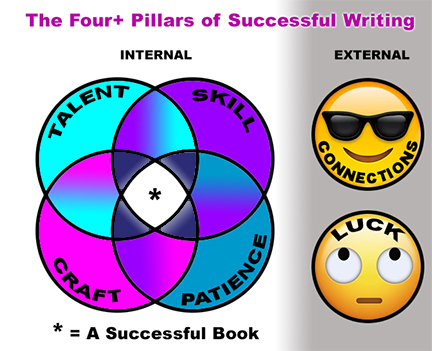
…and the list goes on. Our pillar-theories may vary (we theoretical pillarists), but our intentions are both admirable and identical: The ultimate success of the writer. So, with that in mind, I’ve included my own blend of literary pillarizing. Although I am suggesting a slight twist. I’ve even drawn a Venn Diagram to explain (…a picture being worth a thousand words, after all).
.

A Moderately Helpful (or else utterly confusing) Vennish Diagram.

So let’s dissect this pillary thing, shall we?

The Internal Factors.

• Talent (An innate, inborn capability to concoct and produce a well-written novel). Talent is that inherent ability to tell an interesting story in a unique voice. And then to impress agents and/or publishers with a sterling query. Like chess masters, divas, athletes and multi-platinum selling singer/songwriters, you’re either born with a certain talent or you’re not. Me, for instance. I love music. Learned to play guitar—badly. Practiced daily for years, but never broke out of that meh! stage. The mathematics of music confounded me. (Change keys from G to B-flat? Whaaaa?) I also have a singing voice like a frog in a hailstorm. So no, no amount of dedication was ever going to help. We all can’t be everything we want to be. Just sayin’. Then again, everything we might become is certainly worth a shot. • This attribute is inborn; out of your control or your ability to learn.

• Craft (Technique. Absorbing information. Trial-and-error. Attempting to establish an authorial voice.). Craftsmanship is your ability to learn and develop the rules and mechanics of writing. It means perusing ‘how to’ books on grammar, plotting, narration and dramatic pacing. It means perhaps taking classes or joining a writer’s workshop (which I highly recommend). Or finding employment in a writing-based job—copy writing, advertising, journalism. Or reading manuscripts. Teaching English or Literature. Me? I was a newspaper film critic for several years with a strict 750-word ceiling. Man, that job taught me more about self-editing, about whittling down excess verbiage and getting to the point, and greatly honed my writing abilities. Sometimes it means starting a novel or two, if only to fully develop the necessary knowledge to write a novel that sells. Write until you find your own unique, authentic authorial voice, and then write some more. Realize that it’s okay, perhaps even essential, to blunder, to learn from your mistakes, and then keep writing. • This attribute can be taught and learned.

• Skill (Competence, Expertise, Finesse, Finding your voice). Skill is your ability to realize your potential (an infusion of self-confidence), and then utilize that expertise to its fullest extent. Skill is what results from learning your craft up, down, and sideways, inside and out. Skill is basically Craft 2.0! • This attribute can be taught and learned, but ultimately it’s a personal choice to educate yourself until you’re all but assured of eventual success.

• Patience (Determination, Perseverance, Practice). There’s no other way to finish a novel than to begin. By writing a single line, an infectious opening paragraph, a fully developed first page, you’re making a psychological pact with yourself—that you and your brain are in this for the long run. You’re here for the whole enchilada. Writing a novel is like raising a kid: Less sleep, fewer weekends down at the disco, lots of self-doubt and even a little self-pity. (A little is okay. You’re a struggling artisan after all.) You may be constantly apologizing to friends and family for your prolonged absence. You’re committing yourself because you know you’re competent and talented, even though nobody (yet) may recognize those talents. You’re aware that thousands of other novice writers exist with similar dreams—and if they have a shot, so do you. So you take the leap. Write a page, then another, then another…because that’s the only way home. • Impatience can be considered either an inborn or learned trait—and may take years of practice and dedication to overcome.

* The Sweet Spot. (That tiny white diamond in the middle of the diagram.) If one has the talent, craft, skill and patience to finish a manuscript and begin to pitch the book, the chances of finding an agent or publisher are typically far better than those writers who find themselves lacking in one or more arenas. (If you do find yourself lacking, doesn’t mean that you can’t learn and grow and, in time, prosper.) Which only leaves a single potential speedbump standing between you and Stephen Kingdom—and that’s luck. But read on….

The External Factors.

• Connections (It’s who you know and who knows you). This one may feel a bit disingenuous—but the simple fact is, nepotism and associatism exist and, by all means, if you got it, use it. Is your uncle an editor at Macmillan? That one’s a slam dunk! If you know somebody who knows somebody who works at Simon & Schuster (even in the mail room), or if your great aunt used to date a literary agent in Tuscon—yes! Follow the bread trail. You never know.

P.S.: If you have no connections, and you’re one of those charming extroverts, capable of perfecting your own bow tie, of making a marvelous (shaken, not stirred) Martini, who’s proficient at making friends and connections wherever you go (and if so, good for you) then go for it! As they say in Hollywood, schmooze ’til you lose!

• Luck (Rolling the cosmic dice). This one’s the looming nightmare, the nasty, giggling gremlin who pervades every writer’s hopes and dreams of a book sale. Luck is fickle, unorthodox and totally unpredictable. If your exquisitely written manuscript lands on an agent’s desk who’s hungover or is having marital problems, you may be inexplicably overlooked. A publisher’s assistant who’s going on vacation tomorrow? Same results. Your e-mail query ends up in a junk mail folder. Maybe your insanely well-written novel reminds an assistant editor of a less adept novel that crossed her desk last month, which was nevertheless accepted and that fortunate writer has just signed a contract for a juicy royalty and certain fame. Or maybe you’ve somehow overlooked a typo on page one. (I’ve done that!) It’s sufficient to turn potential good luck to unfortunate, rotten luck.

Speaking of rotten luck, I’ve known a few fiction writers who’ve lost manuscripts in hard-drive crashes, and (of course) the backup’s been corrupted and…well, shit does happen. Aware of Coronal Mass Ejections? Y’know, those giant plasmatic, magnetic fields occasionally spit from the Sun? A lightweight solar flare will cause a pretty aurora. A direct hit from a heavyweight magnetic distortion can potentially fry power grids. Electronic files can (theoretically, at least) be damaged or erased by such an incident. So here’s a new rule. Maybe one of the most important. Rule #98: Make a hard copy (paper) back-up of your manuscript every now and then, even if you’re still working in draft mode. See Finagle’s (aka Murphy’s) Law. But brace yourself.

Here’s a fitting, random comment about blind, stupid luck. Years ago, producers greenlit a film about John Lennon’s life (John and Yoko: A Love Story). The gifted actor chosen to portray Lennon was named Mark Lindsay Chapman. Lennon’s killer was named Mark David Chapman. Yoko Ono so freaked out at the eerily unlikely coincidence that another actor was ultimately recruited to replace him. True story. Bad luck. It exists.

The Hierarchy of Competence

Whether writing a novel or attempting to learn (and master) any of life’s million or so teachable lessons, there’s a savvy little social model that may explain the ‘Pillar Approach’ in somewhat different terms. American Filmmaker Noel Burch’s The Hierarchy of Competence dictates:
.

  • Unconscious Incompetence: Meaning that I’m unaware of a particular skill, or of any necessity to even utilize that skill. (Johnny doesn’t know the difference between a noun and a verb, nor does he care. But, hey, he’s just read a good book and the author’s raking in some pretty big bucks. Johnny rationalizes that anyone can write a novel and make a fortune. It’s not that difficult, right?)
    .
  • Conscious Incompetence: I’m becoming aware of a need for a particular skill, and the rationale for learning the appropriate lessons, but nahhh, I can probably get along by faking it. (After scribbling out 5 atrocious pages, Johnny’s confused and angry to realize that he knows very little about writing a novel. And yet, he persists.) By the way, the persistent part? That’s every writer’s make or break moment—the decision to practice and learn and, hopefully, to go the distance, is crucial.
    .
  • Conscious Competence: I’ve learned a thing or two about a particular craft and, hey, maybe I’m not half bad. But I’m aware there’s lots more info to absorb. (Johnny understands the basics of plotting and the fundamentals of fiction writing by now. He’s read Strunk & White. He’s read Anne Lamott’s Bird By Bird. He’s read Stephen King’s On Writing; he deconstructs novels that he’s read and likes—trying to figure out what ‘makes them tick.’ He’s even signed up for a creative writing class. Sure, he believes he’s pretty good, but he knows he could be better. Time to read a few more ‘how to’ books and then it’s back to the keyboard. Or sharpen that pencil.)
    .
  • Unconscious Competence: After a few years—yup, years—of practice, of trial-and-error, of finishing a dozen short stories that receive good feedback, I’m becoming a skilled writer, in total control (and harmony) with my talent and craft. (Johnny sits down in front of a computer and new worlds unfold before his eyes. He realizes that the act of writing—drafting, composing, editing—is no longer drudgery and anguish, but has recently become a labor of love. Sure, occasional moments of self-doubt, of lethargy and uncertainty may linger, and yet with utmost confidence, Johnny begins his novel. He’s certain he will finish. His thoughts afire, his fingers dance over the keyboard, working in nearly effortless tandem. (Because, yes, those moments do exist.)

Bottom line: Don’t let anyone—not me, certainly not this post—dissuade you from trying. From persisting. Write your freakin’ ass off, until you succeed or something better comes along. So if I can leave you with anything, it’s this:

“To infinity…and beyond!”
. . . . . . . . . . . . . . . . . . — Buzz Lightyear
.


Next post • Previous post • Index
.

Facebooktwitterredditpinterestlinkedinmailby feather

Obstacles

rules-header-full

A notebook for fiction writers and aspiring novelists. One editor’s perspective.

• Next post • Previous post • Index


A Few Common Obstacles.
(And a few possible solutions.)

I’ve been hanging out in Reddit.com/r/writing for a few years now, lurking and occasionally offering comments and suggestions (as u/writer-dude) to new, struggling and/or curious writers. What I’ve discovered on Reddit are many of the same concerns and issues that I’ve confronted while editing clients’ manuscripts. Typically, I can assist confused, foundering or sidelined writers by presenting modest solutions to these six prevalent obstacles. Often times, a writer can self-identify (and overcome) such potential roadblocks and pitfalls. For anyone who might feel lost in the fog, allow me to point you in the right direction. In order of increasing concern:

6. Overcoming Inhibitions. The fear of failure is real. So is the fear of success. A fear of ridicule. The fear of isolation (AKA: Squeezing out sufficient writing time). The fear of upsetting friends or family. The fear of not writing a perfect novel can stop a writer cold. Some call it ‘writer’s block’. Or procrastination. Or ‘waiting for inspiration.’ But the myth of a perfect novel doesn’t exist. Are you a perfectionist? LOOK HERE.

5. How to write effective (or scintillating) dialogue. Oddly enough, extended dialogue can be the culprit, can wander off-track in various ways, and it’s sometimes difficult to find one’s way back. Trimming dialogue can help—keep what’s pertinent and save the rest (the plot-essential chitchat) for another scene/chapter. Not sure? LOOK HERE

4. Overcoming one’s own ineptitude. Don’t have a clue how to write a novel, but starting out anyway? Afraid you’ll never have what it takes to start or finish? The best way to learn is actually to begin writing. You need not begin a novel or a short story, simply write what comes to to mind. Experiment and explore. Make mistakes and discover ways to improve. However, comprehending the fundamentals of being an author (LOOK HERE), as well as digesting filmmaker Noel Burch’s The Hierarchy of Competence, can be an essential guideline to perfecting your craft.

3. Plowing helter-skelter through one’s plot with little regard for scene-setting (equally as important) and character-development (ditto). A great novel should seamlessly blend plot momentum with sufficient scene-setting (where/when/why are we in this particular scene?) and character-development (or else why should we care about these uninteresting people?) Unsure? LOOK HERE.

2. Motivation. (Finding it, Keeping it). There exists two separate (but equal) qualities a writer must possess to write — and finish — a work of fiction. The first is creativity. We’re either born with it or else we take great pains to develop it. (See: Fundamentals.) Creativity is all butterflies and daffodils, rainbows and unicorns. We concoct a lavish daydream, refine and embellish it at our leisure (and that’s the fun part) until we eventually <sigh> attempt to reveal our visions to the world.

The second quality is persistence. (AKA, patience, perseverance, perspiration. A bunch of other P words.) And this is when shit gets real. A writer must begin to dissect, develop and revise that daydream, word by word, page by page, chapter by chapter. For some of us (most of us?) that’s the long haul. The marathon. The sojourn toward potential madness. And yet it’s that excruciating exactitude that a novel demands of a writer. Creativity is a right brain attribute. Developing and writing our daydream is pretty much left brain. A writer must ultimately decide to spend long hours, making tedious decisions, dealing with criticism, confronting many IRL issues (all those pesky things like jobs, family, trepidation and self-doubt.) We all face such challenges, and many writers won’t prevail. Some do. But to complete a novel, we need to engage both the left and right sides of our brain.

1. Getting Stuck. The most prevalent obstacle (by far) is a novice writer beginning a novel (or story) but very quickly becoming mired in the enormity of such a venture. Many newbies have a vague idea or a partial concept in mind and begin to write in earnest—sometimes 3 pages, sometimes 30—but then what? Once the inciting incident (usually a novel’s opening) plays out, how does one proceed to create an entire, enticing, integral book-length manuscript?

Maybe you sincerely yearn to write a novel. Let’s say that you have a nifty premise about a giant asteroid hurling toward Earth. So you create a nice scenario—a young protagonist who’s perhaps an amateur astronomer and who discovers that pinprick of light hurling toward our planet. The inciting incident in the 1998 flick Deep Impact, BTW. And without creating a definitive inciting incident, you may find yourself spinning your creative wheels.

Once you’re able to define your story’s beginning, and know or intuit a potential ending, entire new worlds of possibilities will open up. So many options. So many tentacles. Will the asteroid strike? Will it miss? Will we send astronauts into space with nukes? Or launch a rag-tag team of unlikely geologists to save the world (a la Armageddon)? How does once successfully stitch together a coherent, dramatic, conclusive tale? By writing one page at a time. When you find yourself stymied or cornered or fresh out of new ideas, and you’re still midway through Chapter 1, sometimes writing those next 300-400 pages can feel insurmountable. So take a deep breath and stay in the moment. (Worry about all those other pages when the appropriate time comes.)

One possible solution! If you’re writing in linear, chronological order (as most of us do) and you’re feeling increasingly bogged down, perhaps skip a few scenes or even a few chapters. Pick up your story line at some exciting future point, finish that scene/chapter and then see if you can connect the story from where you’ve left off. I’ll also often write or draft out my final chapter as soon as my ending becomes reasonably clear. I find that by having an ending in place, even a vague outline—it’s far easier to continue my story toward that goal. If I know where I’m going, and why, and my characters know where they’re going, and why, it’s far easier to get there without any wrong turns or unexpected obstacles.

Another potential solution! If you find yourself midway through a decent story, enjoying the ride—but suddenly find yourself lost or writing toward a dead end, stop writing! If possible, give yourself a short break (a few days or a week to clear your mind). When you return, delete (or put aside) your last scene or chapter and restart your story from there—but in an entirely new direction. Give yourself a few options. Maybe outline a few possible ideas that bypass or eliminate the obstacle.

Occasionally a writer may stray off the path of righteousness and suddenly we’ll find our sorry-ass brains mired in the cerebral muck. So by backtracking a few pages (or a few chapters, if necessary) and discovering that proverbial fork in the road, we can choose another way forward. Because very often this change of direction (or detour) will break the log jam. I’ve often used this tactic, and usually with success. However, you must be okay with cutting entire scenes, even chapters, and maybe killing a few darlings along the way. But it’s certainly worth the loss if it gets you back on track.

Other possible solutions….

Q. So, how to proceed?

A1. Outline.

A2. Step away from the project for a few days or weeks, then come back with a fresh perspective. (You can still think about your story, just don’t write until your creativity returns.)

A3. Try approaching the issue from a different character’s POV.

A4. Stop thinking about your story in its entirely. Forget what might happen 100 or 200 pages from now. Focus on one scene, or one page, at a time. Stay in the now. (See: Focus On The Now).

Q. Still feeling creatively stymied?

A. See: More Common Obstacles

.


.

• Next post • Previous post • Index

.

.

Facebooktwitterredditpinterestlinkedinmailby feather

Confronting criticism

rules-header-full

A notebook for fiction writers and aspiring novelists. One editor’s perspective.

• Next post • Previous post • Index


Confronting criticism is an essential rite of passage that every writer faces along that bumpy road toward publication. Whether you accept or dismiss critical feedback may be crucial to who you are and how you will function as a serious writer.

Okay, so let’s keep this simple. Others may disagree but, for me—as both fiction writer and content editor—only two types of criticism exist. Sooner or later, intentionally or not, most writers will confront either constructive criticism or counter-productive criticism. And knowing the difference could determine a book’s success.

If our intention is publication, sooner or later we will face a professional editor’s dreaded red pen. As writers (hoping to become authors) we must allow ourselves the opportunity to accept criticism that can improve the integrity of our work, or else jettison advice which can obfuscate or derail our story. And seeking credible criticism should not be about collecting accolades or kudos, but rather about improving our work. An easy mistake is to confuse positive criticism as constructive criticism and negative criticism as counter-productive criticism because—nope—that’s not how it works. In fact, the opposite is usually true.

Also, when confronting criticism, a word of advice: Leave your dark and stormy writer’s ego outside the door. A writer who won’t or can’t accept criticism will likely not succeed in this biz. (Yup, it’s that important.)

The Casual Critique.
(See The Professional Critique below.)

Early on, most writers are hungry for feedback. Lacking a legion of professional editors, agents and publishers hanging outside the window to help us along, a writer’s left with friends and family and, if we’re lucky, an intimate little writers group. (More about writers groups below.) Sure, there’s nothing wrong with asking the guy next door, a distant cousin who writes greeting card jingles, or our Great Aunt Isabel, for advice. If we trust their intellect and our own instincts, certainly we can enlist their support. However, I suggest treating any familial feedback with cautious optimism. Be wary of a friend or family member’s beaming critique: “Your book is positively stunning. Your writing is poetic, your voice angelic, and your plot absolutely breathtaking.” Such accolades can be the worst possible feedback a writer receives, should they be spoken to placate or motivate (or politely ditch) you. Pleasant words to hear, sure—but ultimately, if spoken without integrity, the joke’s on the writer.

So what’s the difference between a good and bad critique? The difference can be as simple as selecting a proactive listener vs. an indifferent or apathetic listener.

Let’s say you’re writing a murder mystery. Your protagonist is a disgruntled private investigator. The feedback: “Your protagonist does stupid things” isn’t remotely helpful. However, a thoughtful critique such as; “Your protagonist appears to get by on lucky or coincidental occurrences, but never through logic or cunning or self-reliant sleuthing. I think your protagonist needs to be more proactive in solving the mystery” is pretty good advice. Whether or not you’re able to accept such potentially constructive feedback depends upon your ability to free your mind, silence your ego, and consider creative alternatives to your preconceived notions. And writers must trust their own instincts in determining whether or not solicited criticism is valid and useful.

Oh, and you’ll occasionally come upon a troll. Well-meaning or otherwise. But sooner or later we’re all destined to confront a ghastly critique, something like: “This story sucks. Your characters suck. Your writing sucks. Your life sucks. Give up and go away.” (And this isn’t the worst negativity I’ve ever heard befall a fellow writer.) Should this happen, just smile and walk away. Don’t take it personally, because a critique like that isn’t about you. It’s not even a critique. It’s more of a primal scream by somebody who’s frustrated or in over their heads (probably depressed by their own writing failures) — but it’s also important to realize that this sort of crazy comes with the territory. We need to develop a thick skin to survive. No writer has a 100% approval rate. In a roomful of readers, some will like your stuff. Some will think it okay. And some won’t like it. What we do—we write for those who like what we write. Sure, listen objectively to proffered feedback, but trust yourself, first and foremost. Those who disdain our work, we dismiss their comments with a wave of a hand and a quickly uttered, “Pffffffft!” And then we write some more.

The Professional Critique.

A better choice than relying on friends and family for an honest critique might be an alpha or beta reader—a non- or semi-professional editor. A writer can find a host of professional (paid) and non-professional readers online. And, yes, a well-read friend can serve as a alpha/beta reader but, again, seeking criticism shouldn’t be about collecting accolades or kudos. (Signing a publisher’s contract and aggressive book sales will deliver that particular message.) As writers, we’re looking for helpful criticism that identifies overlooked or illogical flaws that weaken or confuse or obscure our writing and/or our message. We’re seeking ways to improve our efforts, and that occurs through occasionally hard-hitting feedback that identifies flaws and, if we’re lucky, offers potential solutions as well.

Note: Typically an alpha reader (much like a content/developmental editor) will look at incomplete or stalled manuscripts, searching for glaring holes, insufficient character developments or illogical motivations; major inconsistencies, unrealistic coincidences and unsatisfying/incomplete endings. An alpha reader can give you suggestions on possible options and paths to follow.

A beta reader (or line editor) will typically accept only polished or almost-finished manuscripts, and will seek out grammatical errors, typos and garbled/unclear word choice or sentence structure. A beta reader may also suggest possible avenues (certain agents, for instance) to pursue.

If you decide to seek out an alpha or beta reader (or even friends and family) for feedback, here are a few guidelines worth remembering:

• Don’t offer a potential beta reader an incomplete manuscript in rough draft mode. If your novel’s in pieces, unfinished and unwieldy, you’re likely to receive feedback in the same piecemeal, uncertain, unwieldy manner. How can a beta reader give any sort of credible advice if the work is raw, unfinished and merely pending? This sort of symbiotic relationship is ultimately worthless, a waste of time for both you and the reader. If your book’s half done, you’re essentially asking someone to test-drive a new car without wheels or an engine. (Although keep reading…)

• If you’re lost in the middle of a novel and seeking advice on how to continue, look for an alpha reader. Instead of offering a half-baked manuscript riddled with blank patches and unfinished thoughts, consider providing a concise summary of your plot in outline form—as comprehensive and detailed a story-line as you’re able. Provide as much complete prose as you can, of course. You should have at least three or four chapters drafted in some detail (so a reader can ground him/herself in your story before perusing your outline or summary.) You’re not looking for polishing or line-editing, you’re seeking basic story options, what might work, what might not—and, technically, not really criticism at all. You’re seeking an alpha reader to help you develop a fictional roadmap from Points A to Z. (Or D to Z, or J to Z, or whatever.) You’re still constructing the puzzle, seeking viable ideas to move forward. But, as my old Granny used to tell me, “Don’t worry about the wedding date if you haven’t found a girl yet.”

• If you’re lost in the beginning of a story—you’ve written 5 or 10 pages of an impending novel and get stuck—stop writing the novel. Seriously. If you like what you’ve written but don’t know how to proceed, change gears! Again, consider outlining before you continue. Or see if you can finish the work as a short story. Give yourself the opportunity to write 10-20 pages with a definitive middle and end in mind. If you find the idea of writing 300-400 pages too daunting, break it down into more manageable pieces. Think of yourself as writing a series of integrated short stories instead of chapters—and worry not about subsequent chapters you intend to write. (See Rule #16: Focus On The Now.) If you find yourself with a complete story, maybe you’re on your way to writing a collection. However, if you find yourself with more to say on the matter—keep writing, one page at a time.

• Conversely, don’t offer friends and/or family—even if it’s your well-intentioned mother!—a complete 300 or 400+ page manuscript and expect an overnight perusal. Or an impartial reading for that matter. Proactive reading (that is, comprehensive understanding and the resulting rational feedback) is a lengthy, intense and often laborious process.

So if you’re looking for erstwhile familial advice, ask for a partial read—perhaps no more than the first 10 or 20 pages of your manuscript. It’s a far less obtrusive, demanding request. Shorter excerpts will prompt more in-depth feedback. If you like the resulting comments, and your reader(s) enjoy the assistance, either ask if they’ll read another 20 (or more!) pages, or wait for them to offer. If you have a friend who’s good at editing and is willing to take on your entire novel, awesome! But consider a bottle of wine or even a cash payment ($100-$200 if you can afford it) in return, or offer an exchange of services if you’re both writers. You can also seek out an outline alpha or beta reader for about the same price. But definitely do some basic research. Some will be well worth the cost — others, not so much.

BTW, I know more than a few writers who are loathe to accept any sort of critical feedback. These writers (some who are struggling with their efforts) abhor suggestions and/or possible solutions to potential problems. They assume—incorrectly—that a novel must be a solitary effort, and that any outside advice somehow diminishes and/or voids the author’s ‘ownership’ of the story. My response is a resounding, “Bogus!” Even if you accept feedback that ultimately dictates that you to rewrite your entire novel—the book is yours and yours alone. Every word that is either axed or that remains resolutely in place (and in what precise order) is ultimately your decision. That’s your call. It’s your book. Period.

Should a literary agent or commercial publisher accept your manuscript, (congrats!) your options are truncated. Both agents and publishers are risking that you (and your manuscript) will be successful and profitable, and once they sign a writer as a client, each will strive to produce the best book possible. With rare exception, that success will be predicated upon your level of assistance.

Do realize that an agents, editors and reputable publishers* won’t have the same visceral connection as you (the writer) to the finished manuscript—and yet each has an invested interest in producing the best possible version of your book. Both an agent and a publisher’s editor have reputations that depend upon assisting you with pristine, professional prose. A publisher has intrinsic knowledge about designing and marketing books, and if you find yourself in that enviable position of being a contracted writer, keep in mind that their opinions count. A legit publisher’s in-house editor has a paycheck to earn. A commercial publisher will drop upwards of $10K simply producing both a printed book (and cover), and an ebook for publication. Mainstream publishers may even risk additional tens of thousands on marketing, PR and in branding you as a viable—meaning capable of producing multiple profit-making or even best-selling books—author.

Agents and publishers who see the value of your work are typically happy to work with you, if rewrites are advised. Your input can be invaluable… but don’t get cocky! As the author, you are no longer in charge. Working with a legit publisher (one who does not charge writers to publisher their work) can be both an exasperating and blissful experience — but the fine art of compromise is essential. If you’re loathe to cut a single word, to rewrite a scene or take erstwhile advice…it’s time for a reality check, because usually their opinions will take precedence. So my best advice? Go with the flow.

A word about writers groups and workshops.

I’m aware that some writers are skeptical (or outright afraid) to join or begin a writers group. For years I was one of those writers. Me? I didn’t need to join no stinkin’ writers group—until, on the advice of a writing friend, I joined one. For several years thereafter, the six (sometimes 7 or 8) of us, all fledgling, earnest but unpublished wannabes, gathered weekly for three grueling hours and learned the fine art of proactive listening.** We also learned to trust one another and, week by week, traded a multitude of often beneficial writing suggestions and solutions.

A writers group can also train you to not only receive, but to offer, constructive criticism. A group/workshop can motivate you to choose words more precisely and write more consistently, and can harden that notoriously fragile, creative psyche—because sooner or later, somebody’s going to hate your book and will delight in telling you so. And when they do, my advice is this: Don’t take it personally. Collecting rejections and weathering disgruntled readers comes with the territory. Just that those of us who’ve already dealt with critical voices are far more immune to the prattle of strangers.

Whenever somebody tells me that they couldn’t get through a story or book of mine, I simply smile and offer my condolences. “I’m sorry to hear that. Hopefully my next effort will be more to your liking.” And, for the more fearless among us: “I’m sorry to hear that. I’d love to know what you found lacking. Would you care to elaborate? Hey, can I buy you a beer?” Because why not turn a close encounter into a learning experience? You’ll seldom receive a more heartfelt critique.

Learning to ignore toxic or misguided criticism—“You’re stupid! You’re ugly! Your mother dresses you funny!” Or, “Your book sucks dog balls!”—really is a valuable life lesson. If and when you eventually learn to shrug off such mindless or insincere criticism—an exquisite, clarifying, joyous occasion, by the way—you’ll find yourself a much happier writer. And certainly a happier person.

But I digress. Personally speaking, I used my experience in a local writers group to eventually attune my brain to hear every criticism about my style, my plot, my characters (good or bad) with an open mind, to evaluate —sometimes for moments, sometimes for weeks—specific bits of feedback that I considered potentially important. I once jettisoned my entire first act—118 pages—because of my group’s near unanimous advice that my story “…really starts on page 119.” Seriously. I gutted one hundred and eighteen pages because my laborious introduction (and way too many secondary characters) did not directly relate to the story that would eventually emerge. I reworked Act I from the ground up and managed to fit my essential introductions into a far more dramatically paced 25 pages, then reworked another dozen or so pages into a feasible segue that blended seamlessly (one could assume) with the remainder of the story. But I spent almost three months pondering the edit before I pulled the trigger and began the rewrites. Still, I don’t regret it for an instant.

One word of advice. If you do find yourself deleting pages, keep a backup copy of your original work. I make constant back-up copies in Dropbox (cloud hosting app), because every once in a while I follow some crazy urge, change or kill a dozen pages, only to realize ‘Nope—stupid move.’ So keep multiple back ups, just in case.

If you’ve been seeking a local writers group and can’t find one, consider starting your own. If you have choices—meaning there are several existing groups in your area—perhaps you can locate other writers in your genre. It’s not necessary of course, just a little icing on the cake. Personally, I think intimate groups of 4-8 can work nicely. Fewer than four opinions and you may find yourself lacking sufficient commentary. With more than 7 or 8 active members, you may discover insufficient reading and critiquing time for each writer. (My weekly group typically ran for 3+ hours. Then tedium begins to creep in. Constructive criticism requires sharp minds and keen observations. So keep it short, keep it sharp.)

With the advent of online forums, writer chats and aggregate communities (such as Reddit’s r/writing) one can find numerous opportunities to meet fellow writers, without even getting out of your ‘jammies. If you can find a few like-minded souls, see if you can branch off into a more exclusive, reliable digital network. The internet—for better or for worse—has negated the need for face-to-face interaction. With the right connections, online interactions can prove just as valuable. Personally, however, I do recommend face-to-face interaction. Writers are hermetic enough. And, like I said, confronting constructive criticism face-to-face builds character.

Writing workshops—those all-day, weekend or weekly events, can provide powerful motivation. Can wield tremendous influence. Can provide a safe haven and a soothing sense of camaraderie. Because, no, you’re not in this alone. But, yes, you’ll pay for the experience, and a week long event (including room and board) can run a thousand bucks or more. Worth the price of admission? Established workshops aren’t for all of us, but for many writers, they can provide a perfect environment to unpack all those tucked away emotions. Because nothing can mess with one’s head more than the isolation of spending three or six or twelve months confronting a manuscript, while everyone else in the world (or so it seems) parties their nights away. Your best revenge is by adding your name to their crowded bookshelves.

I’ve found longer workshops (a week or more) to provide the motivation to keep one writing. You’re ditching reality and jumping down the rabbit hole—spending days in what I consider a sort of cerebral surreality that feels almost psychedelic in it’s intensity, and with the ability to strip the mundanity of everyday existence from your psyche. You’ll eat, sleep and live writing. You’ll bond with other writers, make some nice connections and you’ll even find a few lifelong friends. I found my wife. So, yeah, I highly recommend it.

The bottom line? Sooner or later, every writer can use a good set of alternative eyes. Stephen King had Tabitha. Leo Tolstoy had Sophia, Harper Lee had Truman Capote, and history wonders if Stephen, Leo and Harper would even be published today without the help of some pretty loyal and brilliantly opinionated company.***

Sooner or later, every published writer is expected to expose her/his work, warts and all, to public scrutiny. My suggestion is, the sooner you develop the crucial social skill of accepting criticism, the better. Don’t let your own critical fears (rational or not!) dissuade you from a second opinion. Every writer’s ultimate goal is to be seen by millions. If you can’t imagine your work being exposed to a beta reader or two, I suspect coping with the potentially soul-crushing reality of mass public scrutiny will be far more difficult to endure. (So start small and work your way up!)

Your understanding and acceptance of criticism (both good and bad) is so important, it’s worth repeating. In fact, it’s a new rule. Rule #99: Only two types of criticism exist: constructive and/or counter-productive criticism. Knowing the difference is crucial.
.


* What’s reputable? Agents and publishers who charge a service fee or fee-based services, reputable as they might seem (or actually be!), rely on a writer’s money to stay in business. Many such agents and indie publishers (including in-house editors) can indeed improve the quality of your work. But their professional existence (not your book’s success) is largely based on your bank account, and occasionally on your life’s savings. An unwary writer can spend tens of thousands or more, spend years rewriting based on a bevy of ‘professional opinions’—and still be no closer to selling a commercially viable book. Before signing a contract, ensure that you’re not obliged to pay any up-front fees to ‘ensure potential publication.’

If you’re not sure where to even find a list of reputable agents and publishers, check out Publishers Marketplace. It’s the industry standard…and it’s totally worth your time.

** Active listening vs. Proactive listening: Active listening is the fine art of fully engaging (listening or reading) and comprehending without judgement. Proactive listening requires a full measure of active listening and subsequently offering constructive criticism as well. And what is criticism, after all, but judgement? However, constructive criticism should consist of a fair and accurate assessment—a far more complex and difficult social skill.

*** If you’re into films about writing/writers, check out The Last Station (2009, Christopher Plummer, Helen Mirren). A mesmerizing, dramatic late-life biography of Leo and Sophia Tolstoy.

Also, since we’re here, check out Genius (2016, Colin Firth, Jude Law, Nicole Kidman), a worthwhile biopic of Scribner’s book editor Max Perkins, who shredded (for the best) works by Hemingway, Fitzgerald and Thomas Wolfe. Or look HERE. (‘Tis a list of my personal favorite films about writing and writers.)
.


• Next post • Previous post • Index
.

Facebooktwitterredditpinterestlinkedinmailby feather